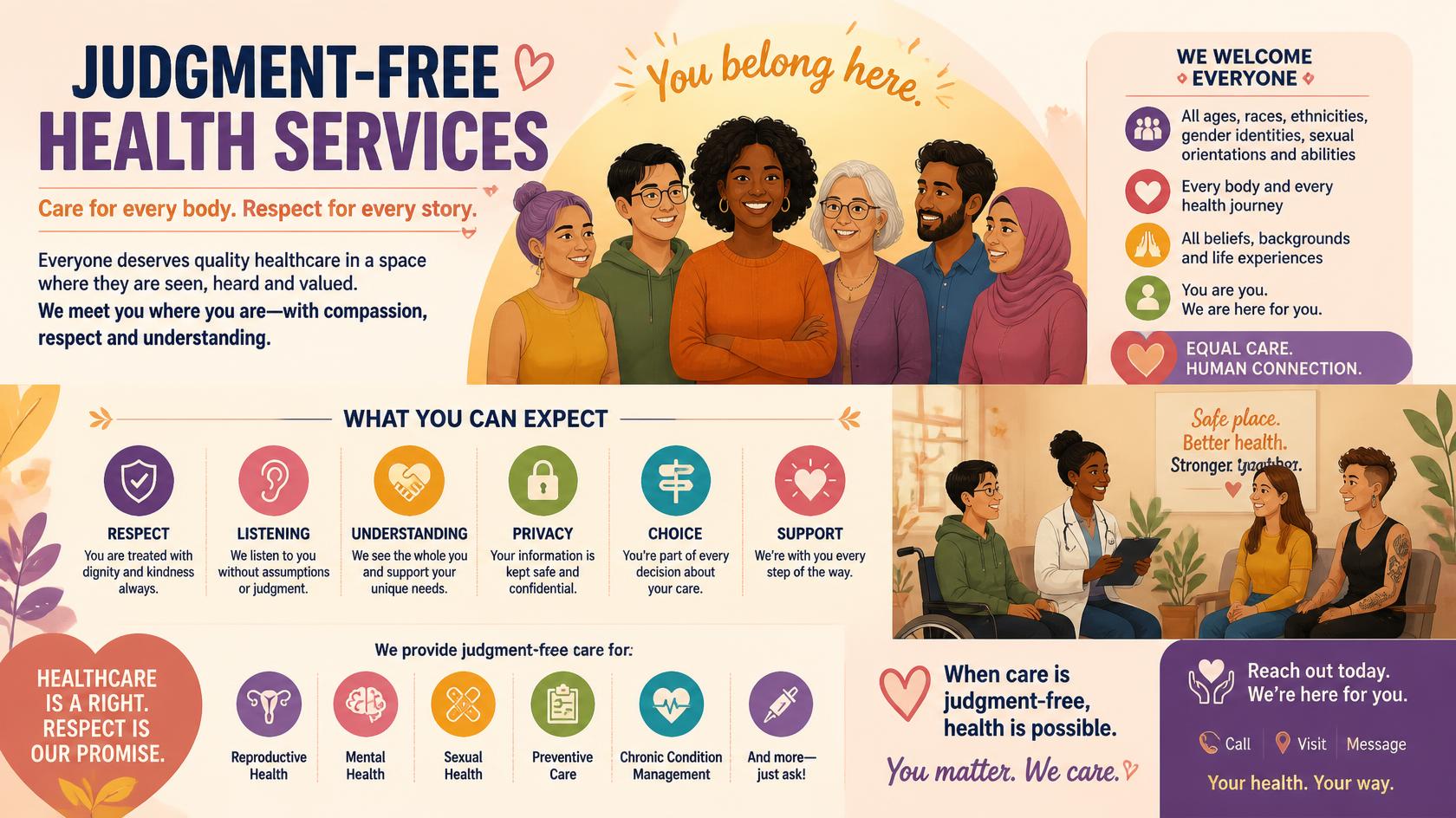
Judgment-Free Health Services: Why They Matter
Judgment-free health services sound like a soft concept — a matter of manners rather than medicine. They are not. For some people, the look they get at a clinic counter is the single thing standing between them and treatment they need.

This post explains what that barrier actually looks like, why it costs more than most people assume, and what a facility can do about it without spending money.
The barrier is not distance or cost
Health planning usually focuses on two obstacles: how far the clinic is, and what it costs. Both matter enormously. However, they are not the only reasons people stay away.
Consider what happens when someone walks into a facility to collect condoms, ask about a symptom, or request an HIV test. If the person behind the counter pauses, looks them over, or repeats the question loudly enough for the queue to hear, the visit has already gone wrong.
That person may still get the service. They will think much harder before coming back.
Multiply that across a year and the pattern is clear. Services exist, supplies are on the shelf, staff are on duty — and the people who need them most are not walking through the door.
Who this affects most
Some groups carry this barrier far more heavily than others.
Young people seeking contraception or sexual health information often face questions about why they need it at all. Unmarried women can encounter the same. People living with HIV may be treated differently once their file is open in front of someone.
For women in sex work, the barrier is at its sharpest. They are among the groups at highest risk of HIV, which means they are exactly the people prevention services are designed for. Yet many will avoid a facility rather than face how they expect to be treated there. Some have had experiences that justify the expectation.
The result is a bitter irony. The higher your risk, the more likely you are to encounter judgment — and therefore the less likely you are to return.
What a friendly corner actually is
The phrase we use for the solution is a friendly corner. It is not a new building or a separate clinic. In most cases it is a rearrangement of what already exists.
A friendly corner has four features:
Privacy at the point of collection. Somewhere a person can pick up condoms or take a leaflet without an audience. A basket in a discreet spot costs nothing.
A conversation that cannot be overheard. A screened space, a side room, or simply a desk positioned away from the queue.
Staff who have been briefed. Not specially trained clinicians — ordinary staff who have discussed in advance how they will respond, and who understand that a reaction costs a return visit.
No unnecessary questions. If a service does not require an explanation, the person should not be asked for one.
None of this needs a budget line. It needs a decision, and someone to follow up on whether the decision held.
Why this matters more as new options arrive
New HIV prevention technologies are reaching Kenya. Long-acting injectable options, in particular, change the shape of prevention because they replace a daily routine with a clinic visit every few months.
That shift is genuinely good news for people who cannot safely keep a daily pill at home, or whose circumstances make daily adherence unrealistic. Nevertheless, it comes with a condition attached.
A long-acting injection requires walking into a facility and being treated decently when you get there. A daily pill can be collected once and used privately. An injection cannot. Consequently, everything about the reception a person expects becomes central to whether the new option works for them at all.
A prevention technology that only reaches people who feel comfortable in health facilities will miss the people at highest risk. Therefore the question of how staff behave is not separate from the question of whether the product succeeds. It is the same question.
What communities can do
Facility staff do not usually intend to turn people away. Often nobody has ever raised it with them.
Communities can change that. In our experience three things work:
Name the specific problem. “Staff are rude” is easy to dismiss. “People collecting condoms have to ask at the main desk in front of the queue” is a description of a layout, and layouts can be changed.
Take it to the right forum. County health management teams, facility management committees, and health dialogues all provide places where this can be raised formally rather than as a complaint in passing.
Follow up. A commitment made at a meeting is worth checking three months later. Ask whether the arrangement is still in place, and whether people have noticed a difference.
This is ordinary accountability work. It uses the same method as any other public service question: document what is happening, submit it properly, return until it is answered.
Dignity is not an add-on
There is a tendency to treat respectful treatment as something nice that a good facility provides on top of its real work.
In reality it determines whether the real work reaches anybody. A clinic stocked with prevention supplies that people will not enter is not delivering prevention. The supplies are simply sitting there.
At Limitless Talk Organization, our work with women in sex work brought this home clearly. Health information mattered. Safety mattered. Economic alternatives mattered. Underneath all of them was a simpler question: is there somewhere a woman can go and be treated like anyone else?
Where the answer is no, everything else built on top of it is weaker than it looks.
Start with one facility
If you work in health, look at your own reception area and ask what a nervous first-time visitor sees.
If you live in a community, find out when your facility’s management committee meets, and raise one specific, describable thing.
Judgment-free health services are built from small changes that cost nothing and require someone to ask for them.
Read about our work on sexual and reproductive health, or get in touch if you would like to work with us on this.